
A Light From The Past
Still standing after 130 years, the Sea Grit Lighthouse is a vivid reminder of the days when its beam guided ships at sea.
Early on a September morning in 1934, the S.S. Morro Castle, an American ocean liner en route to New York City from Havana, Cuba, caught fire off the coast of New Jersey, destined to run aground eventually near the Asbury Park Convention Center. The flames engulfed the vessel, and survivors fled to lifeboats as the deck became too hot to stand on. They huddled in those boats, thrown by the waves and steering toward what they could only hope was the coast of the Jersey Shore—though there was no way to know for sure.
Then, on the horizon, a light.
The Sea Girt Lighthouse rose up like the beacon it was built to be, guiding the lifeboats in the right direction and assuring the people aboard them that safety was in reach. They came aground in Sea Girt and in nearby Spring Lake. The lighthouse then served as a first-aid station as local fishermen and the Coast Guard began a rescue effort. Says Jude Meehan, president of the Sea Girt Lighthouse Citizens Committee: “According to those survivors, seeing the lighthouse gave them hope. Can you imagine what a powerful moment that must have been?”
Powerful” is also a good way to describe the structure itself, with its red brick tower and its solid foundation. First lit in 1896, the lighthouse turns 130 this year. “It was lit for the first time around Christmas,” says Meehan. “It was built in Sea Girt because it’s between Barnegat Light and the Twin Lights of Navesink. With no electric lights, no fires on the shore and not even any buildings with candlelight near the coast, ships kept grounding on sandbars. The lighthouse prevented that.”
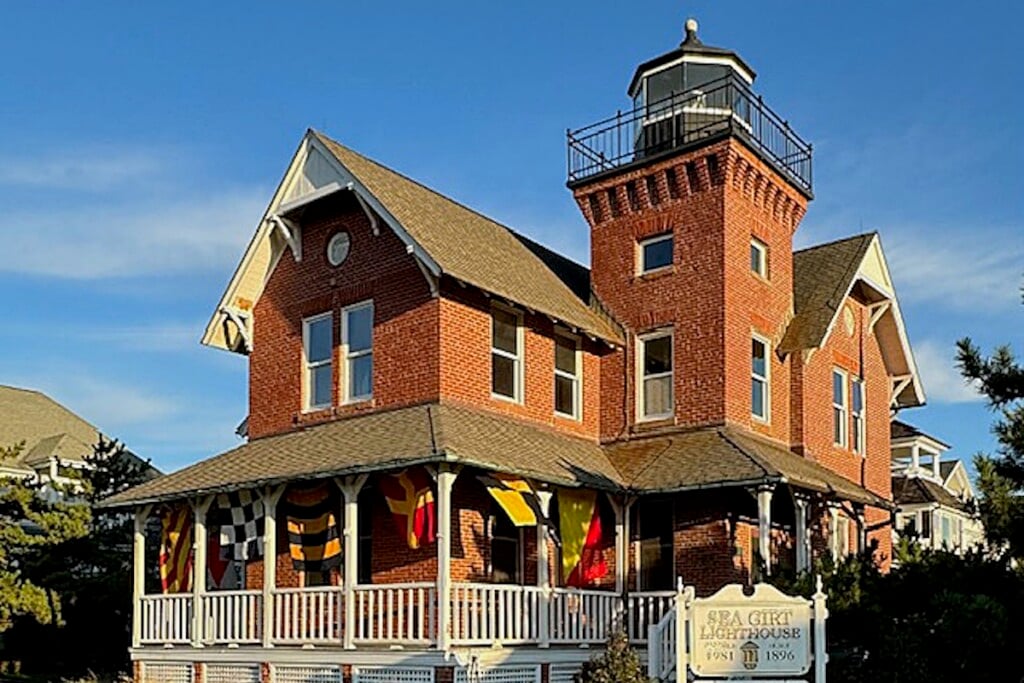
The building itself may look different from your mental image of a lighthouse. Rather than one tower topped with a beacon, like Barnegat’s or the one on the tip of Cape May, “it’s a live-in lighthouse, meaning that the tower isn’t separate from where the lighthouse keeper and his family would live,” says Meehan. The tower climbs up from what could be any other colonial-style house, and the keeper would access the lantern through a staircase.
In 1921, the Sea Girt facility became the first shore-based lighthouse in the U.S. to be outfitted with a radio beacon to aid navigation in the fog. “During World War II, after the attack on Pearl Harbor, the light was darkened and it was taken over by the Coast Guard,” explains Meehan. “It wasn’t relit until all the U-boats were pushed back to Europe. In 1944, they did away with the lighthouse keeper and put a skeleton tower on the north side yard. It went until the early 1980s. It never missed a blink.”
Meehan watched that blink himself. “When I was a kid, my parents would take me on cruises,” he recalls. “We would always stand on the deck that first day out of New York and look for that blinking light off Sea Girt.”
But the days of the lighthouse’s vital role in navigation were long over, as technology had advanced. The old lighthouse keeper’s house served as the town library and a meeting space for many years, but upkeep was expensive and the building needed repairs. In 1980, the town of Sea Girt pondered what to do with the structure, and its future was at risk. That’s where the Sea Girt Lighthouse Citizens Committee enters the story.
“Regular citizens stepped in to form a trust fund,” says Meehan. “It was important to the community that it stay open. It’s a gathering place for artist groups, fishermen’s clubs, ladies’ clubs and more. It draws people here.” Today, the lighthouse is still used as a meeting spot for those community groups along with being a venue for small events. It’s also open every summer for tours, which the citizens committee organizes and runs.
Meehan began his time with the committee as a tour guide in 1996 and still drops by to lend a hand if someone else needs coverage. “My favorite spot, whether it’s hot or cold, is at the very top of the lantern room,” he says. “You look out on the ocean and see the local fishing boats and the big cruise ships on the horizon. The past few years, you’ve been able to see whales. There’s always something to see.”
Though the light in that lantern room is now for decoration only, Meehan says that keeping the Sea Girt Lighthouse standing is more than just a service to the community; it’s a way to prevent history from being lost. “The United States was built on sea trade,” Meehan says. “At one point, we had the best lighthouse service in the world. It’s such an important part of our heritage, and it’s important to remember the sacrifice of the people who would work these jobs for bad pay because they were passionate. Lighthouses were about saving people first and saving ships second.”
No longer a literal aid to navigation, Sea Girt’s facility may point the way nationally toward enlightened historical preservation. “Lighthouses all over the country are falling down from erosion and disrepair,” Meehan says. “But what we’ve done here in Sea Girt shows that if only a handful of people care about a landmark, it’s possible to keep it open for the public to enjoy.”