A Racy 80
Oceanport’s Monmouth Park Racetrack has had eight decades to perfect horse racing and the attendant fun—and it’s just getting started.
In 2018, Monmouth Park racetrack in Oceanport made history. After the Supreme Court declared its landmark ruling in Murphy v. National Collegiate Athletic Association in May, overturning the federal ban on sports betting, the track became the first location in New Jersey to offer the service. On June 14, the first wager was made there—by Gov. Phil Murphy.
“He placed two bets,” says John Heims, Monmouth Park’s longtime general manager, in-house counsel and racing secretary. “He bet on Germany to win the World Cup, and the New Jersey Devils to win the Stanley Cup.”
Murphy went 0-2 on those-2018’s World Cup winner was France, and the St. Louis Blues were the next NHL champs-but the country is still feeling the shock waves of that day. It was the first falling domino that resulted in sports gambling being legalized in 39 states, plus Washington, D.C.
It was not, of course, the first time a Monmouth racetrack figured in the state’s gambling history. The first Monmouth Park opened in 1870, but closed only three years later due to financial troubles. In 1882, under different management, a new Monmouth Park opened its gates and attracted actors, singers and other luminaries. (Former President Ulysses S. Grant had his own box.) It did so well that a new racecourse was built adjacent to it to accommodate demand. That track opened in 1890-but not for long. New Jersey passed a law that banned horse-race betting in 1894 (specifically parimutuel, or “pool” betting). The park was closed and the land sold. For more than 50 years, there was no horse racing on the Jersey Shore.
Then, in 1939, New Jersey re-legalized parimutuel horse-race betting, in no small part because ofthe lobbying of one Amory L. Haskell, a New York City native who was determined to bring horse racing back to Monmouth. In 1946, Monmouth Park reopened its doors with Haskell as president. It’s been going strong ever since, and 2026 marks the 80th anniversary of that version of the institution. It has become an instantly recognizable landmark, a beloved local tradition and an ongoing legacy oftop-quality horsemanship. Up to 1,600 horses live at the track every summer.
“We’re here to promote and celebrate those horses, first and foremost,” says Heims. “Horse racing and New Jersey have been synonymous for a very long time. We have so many horse farms; the horse is our state animal. I am always in awe ofthe number of people one horse can touch-farmers, vet techs, trainers, accountants. It all spreads out from there, and culminates here.”
The setting is certainly worthy. Says Heims: “When people show up here for the first time, they’re shocked by what a beautiful facility it is. It truly is a park setting, with gardens and a lake.”
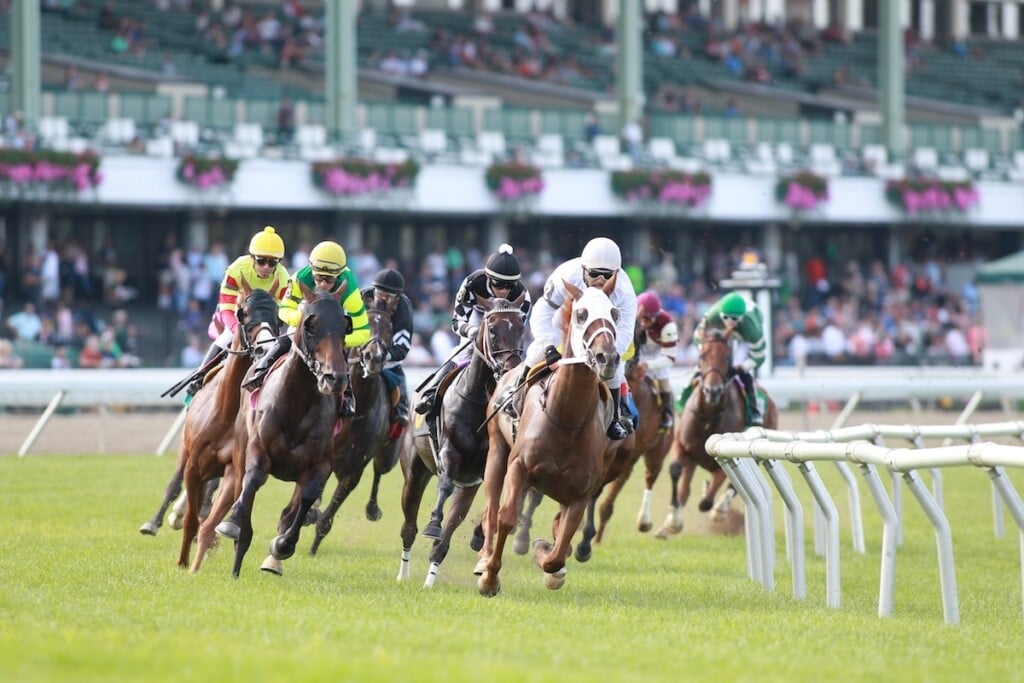
From early May until Labor Day, there are races every weekend-50 in all. They draw talented horsemen and big-name horses from all over the country. In 2015, for instance, the park hosted American Pharoah, who had just become the first Triple Crown winner in 37 years. He competed in Monmouth Park’s signature race, the Haskell Stakes, a Grade I American Thoroughbred race for 3-year-olds held each July. Heims recalls that 6,000 people showed up in the mornings as the park opened to catch a glimpse of the animal.
Nearly 40,000 people attend the Haskell Stakes every year, and the park pulls around 10,000 on most other weekends. Those attendees get their money’s worth. “We try to truly cater to everyone,” says Heims. “If you want to just come with a cooler and a couple of drinks, sit in a picnic area and hang out, we have that. If you want something very high-end, we have partier boxes, opera-style and modeled aftera racetrack in Paris called Longchamp, where Europe’s biggest race is run. Everything in between we can accommodate as well.”
Since the 1980s, Monmouth Park has also been a hub for weekend, open-air festivals, many of them family friendly and filled with both great food and distinctive Jersey Shore charm. Mother’s Day atthe Track opens the season (ladies get free admission and a special brunch is offered) and the BBQ & Craft Beer Festival (with live music and more than 40 craft breweries) closes it out on Labor Day. There are Family Fun Days on Sundays with clowns and face painting. There are food truck festivals and classic car shows. “My personal favorite is Seafood Festival,” says Heims, “because I’ll eat that all day long.” (This year it’s on Aug. 15-16.) He adds, “People come here for something to do-maybe they went to the beach that morning and decided to just stop by. But the atmosphere is what keeps them coming back.”
As times have changed and technology advanced, Monmouth Park has adapted. It was the first facility in the nation to offer a simulcast experience in the 1980s, allowing patrons to watch and wager on races going on at the Meadowlands racetrack in East Rutherford and the Garden State Park Racetrack in Cherry Hill. In a world of legal sports gambling, that adaptation has continued. “We’ve become a technology-based service as well,” says Heims. “People are wagering at home, on their computers and phones. When other racetracks made that move, they stopped drawing in-person crowds. We didn’t.”
Says Heims: “I want any horseman who races with us to leave thinking that Monmouth Park is the best place they’ve ever been. We want to treat them better than any other track in the country, and we want the same thing for our fans. We want everyone to come, enjoy the day and, regardless of the wagering and who won or lost, leave feeling good.”