
It’s Nature’s Turn Again
More and more Bergen residents are renovating their landscapes to make them more sustainable. That means favoring native plants over invasive, non-native species.
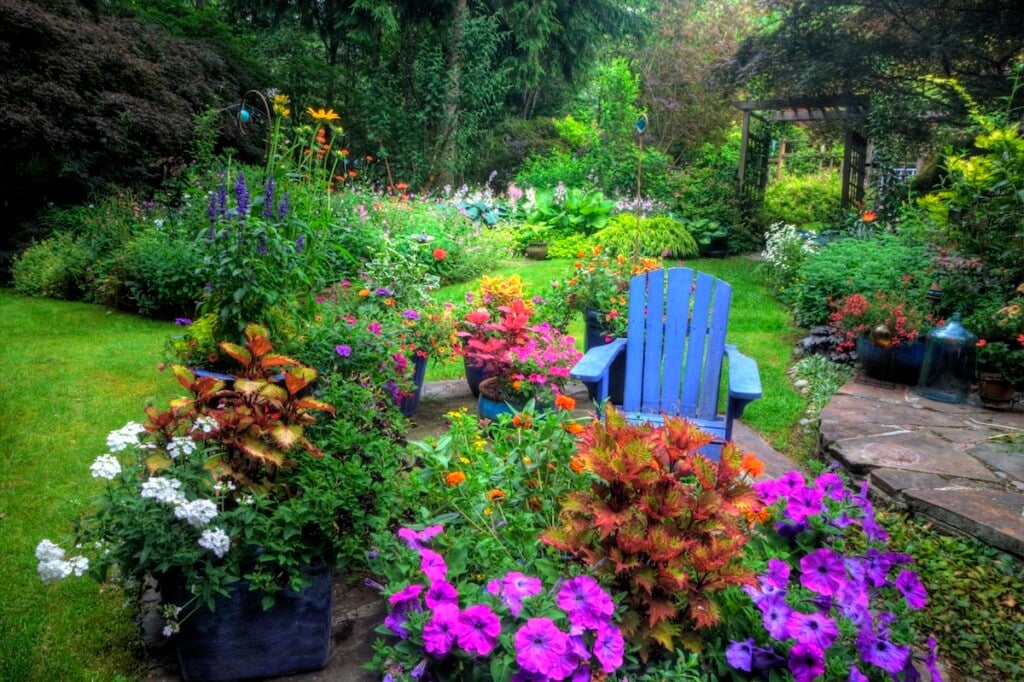
On Jean Epiphan’s 40-by-150-foot property in western Bergen County, you won’t find hostas or daylilies or any trace of English ivy or Japanese honeysuckle. Japanese azaleas? No. Bradford pear? Heaven forbid. Instead, you’ll encounter 167 species, the vast majority of them native plants— such as sensitive fern, its bright, broad fronds lighting up shady spots in the garden, and meadow rue, a tall plant whose profusion of delicate white flowers resemble an explosion of tiny fireworks. Like a growing number of Bergenites, Epiphan has opted to create a more sustainable landscape than the traditional duet of lawn and foundation plantings, with many of the plantings hailing from countries far away.
Sustainable landscaping aims to protect, and not to deplete or harm, natural resources. Epiphan, who also is an agriculture and natural resources agent with the Rutgers Cooperative Extension, notes that “people are starting to learn that we’re in a serious biodiversity crisis”—meaning that we’re rapidly losing species and habitats thanks to human activities like polluting, overdevelopment and yes, filling our gardens with plants native to other countries and other ecosystems. When those plants spread to the wild, many of them crowd out the plants that coevolved with native mammals, birds and insects, leaving those animals with a severely diminished food supply. Bradford pear trees, for instance, may have lovely blossoms and Japanese honeysuckle may smell heavenly, but to the animals that share our yards, they offer little to no sustenance—which is true of most non-native plants.
With that knowledge comes an interest in developing a yard that can help to support biodiversity. In fact, creating a sustainable landscape doesn’t just help the environment; it also reduces the amount of garden work required to keep it healthy. A growing number of landscapers in Bergen are either specializing in sustainable landscaping or incorporating its practices. If you use a landscaper you don’t want to lose, says Epiphan, have a conversation with him or her about which practices you’re interested in adopting. Most landscapers will be happy to comply.
If you’re ready for a full-bore sustainable makeover, or if you just want to take a first step, here’s what you can do to create a landscape that’s more in tune with nature:
• Broaden your beds. When Ramsey resident Thelma Pillepich decided to transform her property into something more environmentally friendly, her first step was to enlarge existing garden beds and install new ones. “We had more grass than we really needed,” she says. Grass is notorious for consuming water and fertilizer, so reducing its presence in the landscape is a good first step toward sustainability. “We’re over-irrigating in the summertime to keep lawns alive when maybe we should have less lawn, more garden beds, more trees,” says Epiphan. The word “less” is key: You can increase the sustainability of your yard simply by reducing the amount of lawn you have—and have to take care of.
• Fix your fertilizer. An essential step toward sustainability, advises Michael Kolenut, “would be to minimize or completely eliminate the use of synthetic fertilizers on your lawn.” Instead, Kolenut, the owner of Lincoln Landscaping in Franklin Lakes, recommends applying a water-insoluble, slow-release fertilizer. As the name suggests, water-insoluble fertilizers don’t dissolve in water. That means that when it rains they won’t run off into our streams and other waterways—and garden runoff is a major source of water pollution in Bergen and elsewhere. Instead, over time (“slow-release”), they’re broken down by organisms in the soil to increase soil quality and fertility. Fertilizers made from composted manure, like Black Kow and Coop Poop, are good organic choices.
• Leave the leaves. We disparage them as “leaf litter,” but in fact, fallen leaves do more for the landscape than any packaged fertilizer ever could. “In those areas where we don’t have lawn,” says Epiphan, “one of the most important things we can do is keep the leaves on site.” Decomposing leaves, she notes, don’t just improve the soil; they also provide winter protection for beneficial insects. She recommends leaving about two inches of leaf matter in garden beds; if you don’t like the look, you can cover them with a thin layer of mulch. Epiphan notes that most of us tend to over-mulch anyway, which, she says, “ends up cutting off air circulation to the soil ecosystem.” If you’ve still got plenty of leaves after adding those two inches to your beds, consider creating a compost pile, which can be tucked away at the back of your property or behind a garage and can be as small as 3 feet by 3 feet.
• Hold on to the water. In recent years, the entire northeastern United States, including Bergen County, has experienced several severe droughts. According to the U.S. Department of Agriculture, that’s likely to continue. So it’s more important than ever to make sure that the rain that falls stays, as much as possible, in our yards. You can do that, Kolenut advises, by creating rain gardens and/or bioswales—ditches with porous bottoms lined with vegetation that direct rainwater to other parts of the property—downhill from your house and downspouts.
To create a rain garden, dig a hole about six inches deep. If you’ve got clay soil—the bane of most gardens—rejoice: It’s perfect for rain gardens. If your soil is sandy or pebbly, mix in compost to make it more water retentive. About a third of the garden should be planted with deep-rooted, water-loving plants such as grasses, sedges and rushes. Other plantings can include whatever species appeal to you, as long as they do well in moist soil.
Rain gardens and bioswales do more than just conserve rainwater; during heavy storms, they help protect against flooding. Another way to mitigate flood danger is to decrease the hardscapes—areas of paved-over soil—in your yard. Instead of concrete pathways, for instance, consider gravel, which allows water to flow into the soil.
• Go native. Two centuries ago, when most of Bergen was still undeveloped land, it didn’t matter much what we planted in our gardens: The mammals, birds and insects who’d evolved here over millennia found plenty of natural food in the wild, still made up almost entirely of the native plants and trees they relied on to survive. But that began to change. In fact, exotic plants from faraway places were all the rage during the Victorian era, among them Japanese honeysuckle and purple loosestrife, two of the most invasive non-native plants now choking out native species in the wild. In our region, in fact, more than a third of plants in the wild are non-native, and 10 percent of them qualify as invasive, meaning they’re likely to spread and overtake our native plants. As these plants invade our woodlands and wild meadows, they’re helping to starve out the animals that once flourished here. That’s one of the reasons why New Jersey, earlier this year, enacted the Invasive Species Management Act, which makes it illegal, without a license, to sell 30 plants deemed invasive, among them Norway maple, tree of heaven, Bradford pear, English ivy, Japanese clematis, multiflora rose and purple loosestrife. (Garden centers and nurseries have until February 2030 to clear their shelves of the designated invasives.)
“Over thousands of years, our flora and fauna have developed a mutually interdependent relationship,” says Kolenut. Consider, for instance, that the only plant on which monarch caterpillars feed is milkweed, and that lady’s slipper orchids can’t survive without a very particular type of fungus surrounding their roots. One of the best steps you can take toward sustainability is to remove non-native invasive plants (among them the above-mentioned purple loosestrife and Japanese honeysuckle, as well as English ivy, multiflora rose and trees like Bradford pear and Norway maple) to keep them from spreading into the wild, and adding native plants to your landscape. (For more, see the sidebar article “Native Heroes of the Plant World.”)
Kolenut says native plants don’t just support wildlife; they also “require less input, meaning watering and fertilization, as they’ve adapted to the local growing conditions.” When Pillepich expanded her garden beds, she filled them with native plants such as winterberry, serviceberry, native viburnum, shrubby St. John’s wort, and decorative grasses like native sedges. The end result: “A lot more wildlife,” she says. “Birds, bees, lightning bugs, just everything.” Three years ago, she bought a small birdhouse and hung it near a serviceberry bush.
When we spoke with her in late April, she was watching a pair of black-capped chickadees build a nest in that birdhouse. “They come back every year,” she told us, “and I get to see them. That brings joy—and we all need some joy.”
NATIVE HEROES OF THE PLANT WORLD
If you’re looking to replace some of your non-native plants with native species—or just to introduce a few natives to your landscape—consider these contenders:
SHADE TREES
• White oak (Quercus alba). A native superhero. Growing to 80 to 100 feet, it supports more than 200 native birds and insects.
• Sugar maple (Acer saccharum). It’s the main source of maple syrup, prized for its striking fall foliage.
FLOWERING TREES
• Redbud (Cercis canadensis). In spring, its branches are blanketed with small, striking purple flowers.
• Serviceberry (Amelanchier). Its lovely white spring blooms give way to purple berries in late spring, supporting a variety of native birds. Its genus also includes a number of bushes.
SHRUBS
• New Jersey tea (Ceanothus americanis). A compact shrub bearing white flowers in midsummer, it attracts bees and butterflies. (If you’re short of tea, you can brew the leaves, as they did during the American Revolution.)
• Spicebush (Lindera benzoin). Its fragrant yellow-green flowers light up the shade garden in early spring.
FLOWERING PLANTS
• Coneflower (Echinacea). Beloved by bumblebees, coneflower comes in a variety of colors and holds its blooms over a long season.
• Bee balm (Monarda). Its red, purple and white blooms attract hummingbirds, butterflies and bees.
GROUND COVERS
• Golden groundsel (Packera aurea). “Golden” is a perfect descriptor for its brilliant spring flowers.
• Wild ginger (Asarum canadense). This shade lover is prized for its large, attractive leaves.
More and more garden centers in our area are emphasizing native plants in their offerings, but if you can’t find what you’re looking for locally, try native specialists online such as Prairie Nursery (prairienursery.com) and Edge of the Woods (edgeofthewoodsnursery.com). For more info on native plants, see the Rutgers fact sheet “Incorporating Native Plants in Your Residential Landscape” (njaes.rutgers.edu/fs1140/).