
Paws For A Reset
The way we treat our pets has changed, and our dogged pursuit of their happiness has spawned a multi-billion-dollar industry
The hotel room was designed to evoke the lemon groves and turquoise waters of the Amalfi Coast, from its ample chaise longue upholstered in beachy, blue-and-white stripes to the fish-and-sailboat stencils on the warm ocher walls. And while its sizable window doesn’t afford a view of the Bay of Napoli (it looks out on a busy road in Fair Lawn, New Jersey, instead), its current occupant, Mama, doesn’t appear to mind. That’s likely because Mama is a slightly skittish calico cat whose idea of exotic travel is a supervised trot around the hotel’s halls.
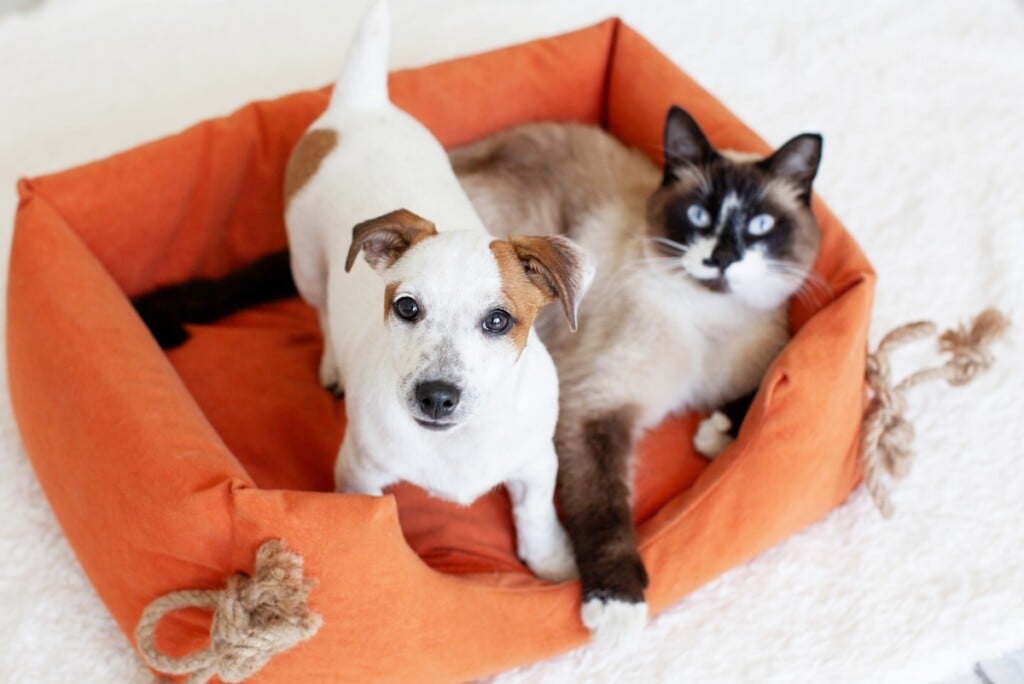
Welcome to the Happy Cat Hotel & Spa. With its 33 themed rooms (like Austin Kitty Limits, Catsablanca and Mama’s favorite, Pawsitano), built-in shelving (should guests feel the urge to scramble up the wall), cubbies for privacy and in-room web cameras (so owners can monitor their felines 24/7), the hotel is emblematic of a sea change in the way we Americans regard—and treat—our pets. They’re no longer merely family-adjacent, but full-fledged family members who are thought to deserve the same kind of care we afford our children and ourselves.
“Pets are not just pets,” says Mia Frezzo, D.V.M., a veterinarian at the Animal Hospital of Hasbrouck Heights. “They’re not just dogs and cats; they’re our clients’ children.” Caryl Blank, who shares her Fair Lawn home with three cats, says of them, “They’re my people.” It’s a sentiment echoed by Mahwah’s Natalie Maniscalco, whose mixed-breed dog Louie is, she says, “very much part of the family.” No doubt, many of Bergen County’s 170,000-plus pet owners (the most of any county in the state) feel the same.
And there are more pet owners, in Bergen and across the country, than ever before. In 2018, according to the American Pet Products Association National Pet Owners Survey, 67 percent of households in the U.S. included at least one pet. By 2026, that percentage had climbed to 71.6, thanks, in part, to the pandemic, during which many of us adopted dogs, cats and other animal companions to ease the sting of lockdown—and also because young couples are waiting longer to have their first child, but not their first “fur baby.” Maybe, in our unsettled era, pet owners are looking for comfort they may not be able to get from other humans, and in exchange for that comfort, they’re willing to spend time and money to ensure their pets’ happiness. Whatever the reason for the rise in pet ownership, as the way we regard our pets has changed—and their numbers have grown—the way we care for them has changed as well, along with the industry that’s expanded to serve them—and thereby please and comfort us.
A HEALTHCARE REVOLUTION
“Over the past 20 or 30 years,” says Frezzo, “the advancements in medicine have been incredible. And the ability for our clients to achieve the level of care that they want for their pets has paralleled those advancements.” Today, there are nearly as many medical specialties for animals as there are for humans, including ophthalmology, oncology, orthopedics, cardiology, neurology, radiology, physical therapy and rehabilitative medicine. Total hip replacements for both dogs and cats are becoming increasingly common, and dogs can also undergo knee, elbow and ankle replacement. Just as humans can track their health and fitness with monitors like Fitbit, dog and cat owners can now equip their pets with a tracker to monitor heart rate, respiration, physical activity and sleep, and view all of that information on their phones.
And as alternative treatments carve out a growing role in human medicine, pet owners and vets are increasingly turning to them as well. Frezzo incorporates the use of essential oils in her practice, and other vets offer chiropractic, acupuncture and swim therapy, among other nontraditional modalities. There are vets who specialize in pet hospice and others, like Bethany Hsia, D.V.M., who offer in-home euthanasia. Hsia, the cofounder of CodaPet, which serves pet owners in and around Bergen County, says that demand for her service has increased. “It allows the family to write the story that they want to write about this end-of-life space,” she says. Some pet owners choose to play music or gather the entire family, including other pets, or opt to have the procedure done in a pet’s favorite spot. And home euthanasia eliminates the potential trauma of a trip to the vet’s office.
BEYOND KIBBLE
Increasingly, vets are providing special food for pets with food allergies or sensitivities—or whose owners simply seek an alternative to the cans and bags that line the supermarket aisle. They can also find those alternatives at online sites like chewy.com or specialized pet-supply stores such as PetSmart and PetCo. Fresh (refrigerated) and raw foods, as well as high-protein, organic and grain-free offerings are a growing segment of the so-called premium pet-food market in the U.S., which was worth more than $2.6 billion in 2025 and is expected to increase to $5.4 billion by 2034, according to the website Verified Market Reports.
It’s not just our pets’ health that we’re concerned about; it’s also their happiness. “If cats aren’t happy with their food,” says Blank, “they’re not going to be happy with their life.” She’s continually trying new foods to sustain her cats’ joie de vivre. “When I go food shopping, people look at me like I’m a crazy person—I have so many different brands in the cart,” she says.
TRAINING WITH LOVE
It’s not surprising that, as we increasingly view our pets as family members, the way we train them is shifting from punishment to positive reinforcement. True, some trainers—and some pet owners—still use punitive techniques such as fitting a dog with a prong collar, which applies uncomfortable pressure to its neck when it pulls on its lead. But more and more trainers and owners are opting for what Cresskill-based certified dog trainer Brooke Greenberg calls “the kindness method.” This approach, she explains, “relies on utilizing something the dog likes—treats, play, affection—to get the behavior you want.” In fact, the American Veterinary Society of Animal Behavior has concluded that “positive reinforcement, utilizing rewards, is the best way and the most effective way to get the behavior that we’re looking for from our animals.”
IT’S A TRIP
More and more of us want to take our pets with us when we travel, and the booming pet-friendly hotel industry reflects that desire. Worth $4.6 billion in 2025, the market is expected to nearly double within the next five years, according to The Business Research Company, with major chains like Marriott, Hilton, Hyatt, Wyndham and Kimpton eager to welcome four-legged guests.
Flying with cats and small dogs (or rabbits, if you’re a bunny “parent”) is relatively easy, as most airlines allow you to travel with your pet in a carrier that fits under the seat. Fees generally range from $100 to $300 per carrier. Larger dogs pose more of a problem because they may have to fly in the cargo hold—an unacceptable alternative for many who view their pets as family. That helps to explain why the past few years have seen the founding of airlines that specifically fly pets (along with their owners) in a style that most business-class travelers would envy.
Ridgewood’s Susan and Bob Burke were eager to spend several months in France, but they couldn’t imagine taking such a prolonged trip without their dog, Watson. “He misses us terribly when we’re away,” Susan explains. A 35-pound Lagotto Romagnolo, Watson clearly wouldn’t fit under an airline seat, and the couple were unwilling to have him travel in the cargo hold, so they opted to fly with him to France on Bark Air. Founded in 2024, the airline allows dogs to fly with their owners in the cabin and offers suitable snacks and meals to all of its passengers. RetrievAir, founded in 2025, is a similar airline for pets and their people, while private carriers like K9 Jets offer an even more luxurious alternative.
And, of course, if you can’t travel with your pet, you can book him or her into a pet hotel that offers more than just comfort. “Our clients are looking for next-level care,” says Lauren Vecchione, owner of the Happy Cat Hotel & Spa. “Twice a day, we monitor how much their animals are pooping, peeing, eating and drinking. I have an Excel spreadsheet that I review.”
THE PURSUIT OF HAPPINESS
When Mama isn’t lounging in her suite at the Happy Cat Hotel, you’ll likely find her chilling on her fenced-in Ridgewood porch. “I know that makes her happy,” says her owner, Candice Brogan. And making our pets happy is paramount, whatever it takes. Louie, for instance, accompanies his owners to outdoor movie nights and for long rides in the car. And though he’s in possession of what owner Maniscalco calls “two massive beds,” he prefers to snuggle with his humans overnight. “Originally, we weren’t going to allow him to do that,” she says. “But we allowed him to do that.”
In many households, pets have almost as many toys as their young human counterparts. Every three months, for instance, Blank’s three cats receive a themed box of playthings. “The theme could be Down by the Shore, with beach balls and beach blankets, or Fireman or School,” she says. “I sit on the floor, and they all come to help me unbox it.”
And while many pet owners heed their veterinarians’ advice to keep their fur babies (especially cats) indoors when off the leash, owners are increasingly determined to offer pets the joys of fresh air and sunshine. Consider the catio—a screened enclosure, either freestanding or connected to the house with a flap or a tunnel, that allows felines to feel the wind in their fur. Boosted by the pandemic, the global market for catios is currently valued at $1.2 billion and expected to double over the next decade, according to Growth Market Reports. And dog owners who allow their pets to enjoy the freedom of a fenced-in yard can now have that yard professionally swept clean of dog detritus. Companies providing that service in Bergen include Poop 911, DoodyCalls and Bergen County Pooper Scoopers.
AND IF THEY ROAM . . .
Given how much we pamper and protect our pets, it’s clear that making sure we don’t lose them is high up on our list of concerns. Today, virtually all vets offer their clients the option of microchipping their pets, a simple procedure that involves inserting a tiny integrated circuit, containing an ID number linked to the pet’s owner, under its skin.
“I think nearly everybody microchips their pets,” says Frezzo, who notes that pet owners need to update their information if they move or change phone numbers. It’s not a perfect system: “The pet has to be found and brought to a place where it’s going to be scanned, like a veterinary hospital or a shelter,” Frezzo notes. That’s why she also recommends adding a GPS tracker (similar to an Apple AirTag) that can tell you where your pet is in real time via your cell phone (as long as you and your pet are in an area with cell service). Keep in mind that even the most cosseted and cared-for pet can get out if it’s sufficiently spooked (by thunder, say, or fireworks) or simply takes a notion to check out the wild world beyond your front door.
If you encounter what you think is a lost pet, the American Animal Hospital Association advises approaching it with caution. If you can’t corral it, or it doesn’t seem friendly, call animal control or a local pet rescue. If it allows you to approach, check for an ID containing contact information and get in touch with its owner. Otherwise, take it to a place where it can be scanned for a microchip—a veterinary hospital, say, or a shelter. If that doesn’t end in success, inform local veterinary hospitals, shelters and animal control departments and post a photo on social media. Even if you’re not a pet owner, you can help a lost pet by trying to reunite it with its family.